If you’re honest about it, most days look the same.
You wake up, sit at a table or desk, sit in a car, sit at work, sit again at home, then sit in front of a screen until you go to bed. Even people who “work out” still spend most of their waking hours folded into a chair.
And your body notices.
Hips get tight. Glutes shut down. Lower back starts taking over jobs it shouldn’t be doing. You stand up and feel stiff, slow, and slightly broken for the first few steps.
That’s not age. That’s sitting.
When you sit for long stretches, your hip flexors stay shortened, your glutes stop firing properly, and your movement gets limited. Even when you stand back up, the effects don’t magically disappear. You carry that stiffness with you into workouts, walks, and everyday movement.
Over time, it shows up as back pain, knee pain, poor posture, and a general feeling that your body doesn’t move the way it used to.
The Hard Science on Sitting
This isn’t just anecdotal or “you’re getting older”. Large population studies have been pointing at the same thing for years: long periods of sitting are directly tied to worse health outcomes, even in people who work out a few times a week.
People who sit most of the day have higher rates of:
- chronic low back pain
- hip and knee problems
- poor posture and limited mobility
- cardiovascular disease
- metabolic issues like insulin resistance
And here’s the part that surprises people:
Working out doesn’t cancel it out the effects of sitting.
Research out of places like Mayo Clinic and the World Health Organization has shown that you can hit the gym regularly and still pay a price if the rest of your day is spent planted in a chair. Long, uninterrupted sitting creates its own damage pattern.
On the movement side, studies consistently show that prolonged sitting:
- reduces glute activation
- shortens hip flexors
- limits hip extension
- forces your lower back to compensate
Which explains why people stand up feeling stiff, slow, and unstable — especially after hours at a desk or in a car.
Even short movement breaks matter. Data shows that standing up, walking, or moving every 30–45 minutes measurably improves circulation, joint function, and metabolic health.
Humans weren’t designed to sit for eight to twelve hours a day.
You don’t need complicated fixes. You need movement in the right places.
Below are simple stretches and exercises that help undo the damage sitting causes—especially in your hips and glutes.
First: Sit Less, Move More
Before getting into exercises, this needs to be said plainly.
No stretch will save you if you sit all day and never move.
If you can stand more during the day, do it. If you can’t, break up sitting every 30–45 minutes. Stand, walk, move around for a few minutes. It doesn’t need to be dramatic.
The goal isn’t to replace sitting with standing all day. That has its own problems. The goal is variety. Your body handles change well. It hates being locked into one position for hours.
Think movement, not optimization.
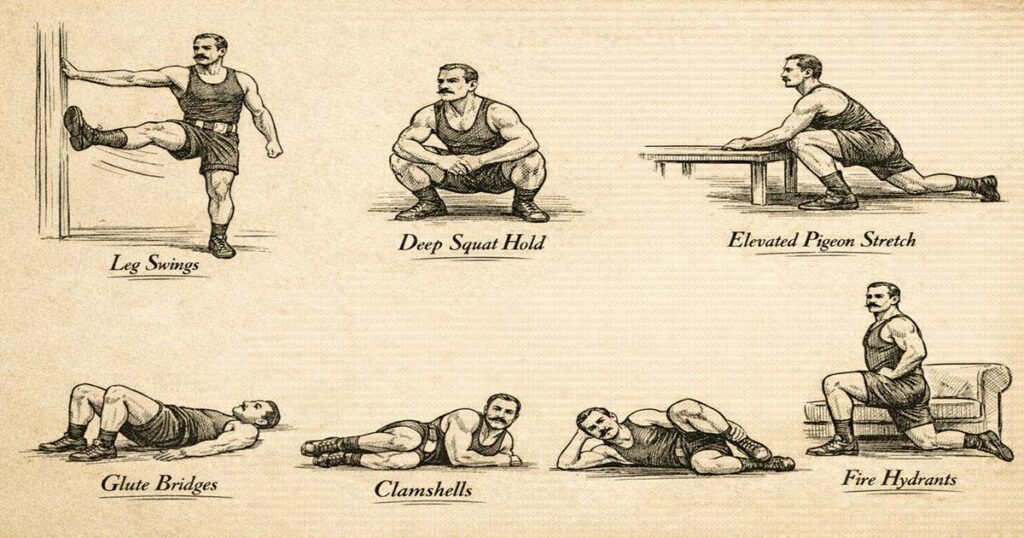
Loosen Tight Hips
These are meant to restore basic mobility. Do them before workouts, after work, or whenever your body feels locked up.
If something feels intense, back off. Stretching shouldn’t feel like punishment.
Leg Swings
Hold onto something for balance. Swing one leg forward and back, gradually increasing the range as things loosen up. Do about 20 swings, then switch legs.
Then swing side to side. Out to the side, then across the body. Again, 20 swings per leg.
This wakes up the hips, hamstrings, and glutes without forcing anything.
Deep Squat Hold
Get into a full squat with your heels on the ground. Let your hips drop all the way down. Keep your chest up and your back neutral.
Hold for 30–60 seconds.
You’ll feel it in your hips, groin, ankles, and lower back. If you can’t get all the way down yet, that’s fine. Work toward it.
This position used to be normal for humans. We just stopped using it.
Elevated Pigeon Stretch
Place one leg on a table or bed with the knee bent. Lean forward slowly and hold.
After holding straight on, lean slightly left, then slightly right, holding each position for 60–90 seconds. Switch legs.
This opens up the hips deeply without putting a lot of stress on the knees.
Couch Stretch
Place one knee against a couch or wall behind you. The other foot stays planted in front. Slowly bring your torso upright while squeezing your glutes and bracing your core.
Hold as long as you can manage—up to a few minutes if possible—then switch sides.
You’ll feel it straight through the hip flexors and quads. If you sit a lot, this stretch matters more than almost anything else.
Wake Your Glutes Back Up
Sitting turns your glutes lazy. When they don’t do their job, other muscles compensate—usually badly.
These exercises help turn them back on.
Glute Bridges
Lie on your back with knees bent and feet flat. Drive through your heels and lift your hips while squeezing your glutes.
Lower and repeat.
Start with bodyweight. Add weight later if you want. Three sets of ten is plenty.
Clamshells
Lie on your side with knees bent. Keep your feet together and raise the top knee without rotating your hips.
Slow, controlled reps. You should feel it directly in the glutes.
Do 20 reps per side for a few sets.
Fire Hydrants
Hands and knees, spine neutral. Lift one leg out to the side while keeping it bent.
Control the movement. Don’t rush it.
Fifteen reps per side, a couple sets.
The Real Fix (That Nobody Wants to Hear)
All of this helps. It really does.
But here’s the part most fitness articles won’t say clearly:
You can’t stretch your way out of a life spent indoors.
You don’t fix a sedentary life with perfect mobility routines. You fix it by living less like furniture.
Go for long walks through the city.
Walk uphill.
Walk uneven ground.
Head into the mountains.
Carry things.
Climb stairs.
Wander without a plan.
Your body was built for movement, not management.
Do the exercises if you want—they’re useful.
But don’t confuse maintenance with living.
Most stiffness disappears when you stop sitting still and start moving through the world again.