Yeah, I know — some people are going to get all butt-hurt over the title. But that’s actually kind of the point.
Your perception determines your reality. The story you tell yourself becomes the program your brain runs. And sometimes the most effective program isn’t polite or socially acceptable — it’s deliberately delusional.
Retard maxxing” (also spelled retardmaxxing or retard maxing) is an internet slang term and mindset/philosophy that encourages taking bold, instinctive action without overthinking. It is the philosophy of ditching analysis paralysis, perfectionism, overplanning, and rumination — and instead just starting to do shit, acting on gut instinct, embracing mistakes, and adjusting as you go, even if you look like a “retard” at first.
This mindset is nothing new…
In the 18th-century samurai classic Hagakure, Yamamoto Tsunetomo captured the exact same spirit when he wrote:

“Bushido is to enter a ‘death frenzy’ (shini-gurui). Even dozens of men cannot kill a man in a frenzied state already determined to die… Just become insane and desperate to die… Don’t think of loyalty or filial piety, just enter a frenzy to perish in shidō.”
The samurai understood: hesitation kills. Overthinking is death. True power comes from committing fully and acting without second-guessing.
This isn’t the motivational bullshit you will read in modern day self-help books. It’s a psychological weapon: manufacture an extreme, irrational state of mind so powerful that hesitation, fear, and self-doubt are burned away. Modern science is now proving Yamamoto was right — and that “retardmaxxing” (leaning hard into delusional optimism) is a legitimate performance hack.
The Placebo Sleep Study That Proves Your Mindset Runs the Show
In 2014, Christina Draganich and Kristi Erdal ran a clever experiment (PMID: 24417326). They had 164 participants report their previous night’s sleep, then randomly lied to them.
- One group was told they had “above average” sleep quality (28.7% REM).
- The other was told they had “below average” sleep (16.2% REM).
Actual sleep was identical across groups.
Result? The people told they slept great performed significantly better on cognitive tests measuring attention, processing speed, and verbal fluency. The “poor sleep” group performed worse. Their assigned (completely fake) sleep quality predicted performance. Their real sleep did not.
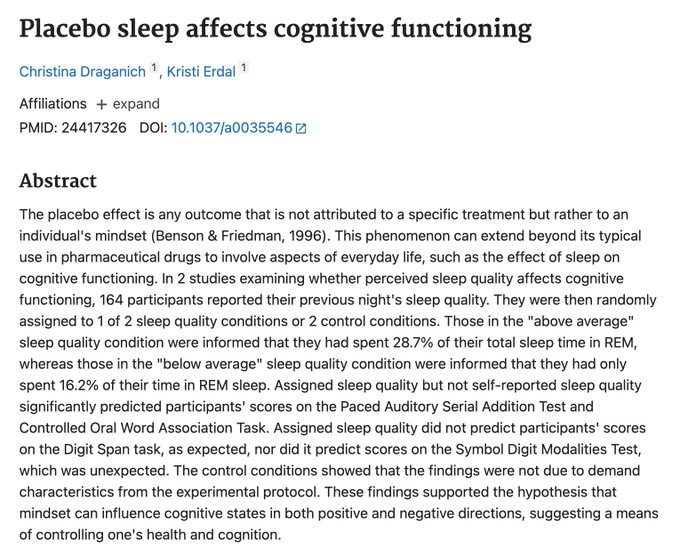
The researchers concluded: mindset can influence cognitive states in both positive and negative directions. Your brain doesn’t know the difference between real confidence and manufactured confidence — it just runs the program.
Rumination: Why Focusing on Problems Makes You Worse
The opposite of delusional optimism is equally proven — and far more destructive.
In their landmark 1995 study published in the Journal of Personality and Social Psychology, Sonja Lyubomirsky and Susan Nolen-Hoeksema tested the effects of self-focused rumination across three experiments with dysphoric (mildly depressed) and non-dysphoric participants.
The results were clear and should really scare the shit out of you if this is how you run your life:
- Dysphoric participants induced to ruminate generated more negative, biased interpretations of events.
- They produced fewer effective solutions to interpersonal problems than both non-dysphoric controls and dysphoric participants who were distracted from rumination.
- In all three studies, dysphoric people who distracted themselves performed as well as non-dysphoric participants on problem-solving tasks.
Rumination didn’t just feel bad — it actively impaired the cognitive tools needed to fix problems. Ruminators stayed stuck in pessimism, over-analyzed flaws, and generated weaker action plans. Distracted dysphoric participants, by contrast, were optimistic and effective.
Decades of follow-up research have reinforced the pattern. Rumination amplifies negative mood, increases recall of negative memories, worsens executive function, and predicts longer and more severe depressive episodes. It doesn’t make you more “realistic” — it distorts your perception, shrinks your options, and makes you objectively worse at life.
Focusing obsessively on how tired, stressed, flawed, or behind you are doesn’t give you an edge. It hands your brain a garbage program and tells it to run at full speed.
Meanwhile, placebo studies, positive illusions research, and every high-performer from samurai warriors to Michael Jordan show the reverse: the right kind of manufactured mindset expands capability. Rumination contracts it.
Take Miyamoto Musashi — undefeated in over 60 duels. He didn’t fight hoping to survive. He fought as if he was already dead. By deciding the outcome in his head first and removing all fear of loss, he moved with total freedom and ferocity. That manufactured certainty gave him an edge no “realistic” opponent could match.
Michael Jordan did the same thing on the court. He missed over 9,000 shots and lost nearly 300 games, yet he still demanded the ball with the game on the line — 26 times. Why? Because in his mind, the shot was already going in. He wasn’t being realistic about his failure rate. He was running a delusional program that said “I’m taking this and I’m winning.” And more often than not, reality bent to match his delusional thinking (or what some might call his winning mindset).
Your attention is a scarce fucking resource. Where you point it determines what your brain builds — either a self-fulfilling prophecy of limitation, stress, and mediocrity, or one of momentum, action, and wins.
Positive Illusions: Why Your Brain’s “Delusions” Are Actually a Superpower

Look, for decades psychologists assumed that the healthiest minds were the most accurate ones — cold, clear-eyed realists who saw themselves and the world exactly as they are. Then Shelley Taylor and Jonathon Brown dropped their bombshell 1988 paper in Psychological Bulletin and flipped that entire assumption on its head.
After reviewing a mountain of evidence, they showed that mentally healthy people routinely hold three major “positive illusions”:
- They view themselves in unrealistically positive terms (yeah, you probably think you’re above average in more areas than you actually are).
- They exaggerate their sense of control or mastery over events.
- They maintain unrealistic optimism about their future.
These aren’t signs of pathology or clinical delusion. Quite the opposite. Taylor and Brown argued — and the data backed them — that these mild positive biases are characteristic of normal, well-adjusted human thought. People who hold them tend to be happier, more persistent in the face of setbacks, form better social relationships, and show greater overall psychological well-being.
In other words: your brain’s slight disconnect from raw reality isn’t a defect. It’s a path to success — an evolved psychological tool that helps you get shit done.
To win any battle, you must fight as if you are already dead.
– Miyamoto Musashi
Why Overconfident People Often Crush Accurate Realists
People who overestimate their abilities don’t always win because they’re secretly more talented. They win because they act like they are. They:
- Take more action and bolder risks
- Persist longer when things get hard
- Bounce back faster from failure
- Create self-fulfilling prophecies through sheer momentum
Accurate realists, by contrast, often hesitate, play it safe, and talk themselves out of opportunities before they even start. The research on positive illusions shows this pattern repeatedly: slight overconfidence fuels the behaviors that lead to better real-world outcomes.
It’s the same mechanism we saw in the placebo sleep study. Your brain doesn’t run a perfect simulation of reality — it runs the story you feed it. Give it a story that says “I’ve got this,” and it mobilizes energy, focus, and creativity accordingly. Feed it “I’m probably going to fail,” and it conserves resources and half-asses the effort.
This isn’t woo-woo. It’s how high performers have operated forever. The samurai entering a death frenzy, Bruce Lee refusing to entertain negative thoughts, Michael Jordan demanding the ball with the game on the line — they weren’t being “realistic.” They were deliberately installing a winning program.
Dr. Joe Dispenza puts it perfectly in You Are the Placebo:
“Your personality creates your personal reality. Your personality is made up of how you think, how you act, and how you feel.”
The Science of Going Slightly Insane: Why Delusional Optimism Beats Realism

Look, there’s obviously a line here.
If you go full fucking retard — no feedback, pure delusion, ignoring everything — you’re gonna crash and burn.
But there is that sweet spot. The kind of mild delusional optimism that normal, high-performing people already run on without even thinking about it. Back in 1988, Shelley Taylor and Jonathon Brown showed that mentally healthy people naturally think they’re a bit better than they are, believe they’ve got more control than they do, and stay weirdly optimistic about the future. And guess what? Those little “illusions” aren’t a bad thing — they’re the advantage you need.
That tiny bit of extra belief is exactly what separates the guy who actually goes for it from the “realist” who’s too busy being accurate to ever do anything.
So yeah — next time you feel yourself getting a little cocky, a little ahead of the facts… don’t shut it down. Lean the fuck in. Retardmaxx it on purpose.
Your brain doesn’t sit there fact-checking you. It just runs whatever program you give it.
Stop playing small with all this “being realistic” bullshit. Install the delusion program. Walk around like the main character — because in your life, you are.